
Exposition: L’Ankou, l’Enfer et le Paradis. Rites & Croyances autour de la mort en Bretagne

Exhibition
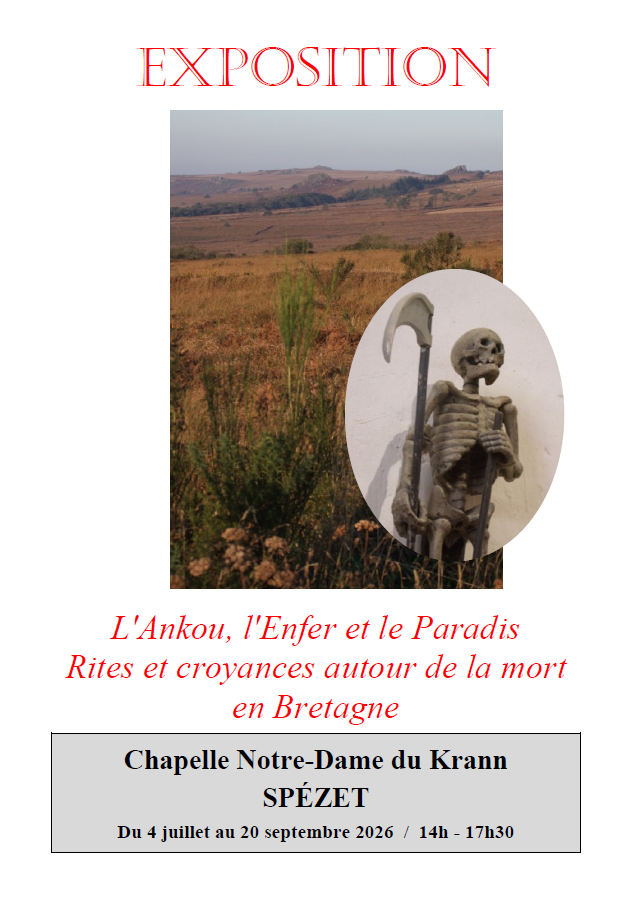
The Ankou, Hell and Paradise. Rites and Beliefs surrounding death in Brittany.
The exhibition is presented as a logical sequence of events: a Breton is warned by a
sign that he is about to die. But, being stubborn, he is not ready to leave this world and goes to consult
several oracular fountains to find out what is to be expected: those of Trévars in Plomeur (29) or Notre-
Dame in Rumengol (29).
Eventually, the Ankou strikes and he lies on his deathbed. His family refuses to give up hope and once again consults the
fountains, using the invocation ‘To life, to death’. In Hénansal (22), a horseshoe is used; if
it floats in the fountain’s water, the sick person will survive.
Specialised saints are also consulted, such as Saint Délivrant in Kernascléden, Saint Guinefort in
Lamballe, Saint Languis in Plougastel and Saint Diboan in Gourin, Leuhan or Plévin – also known as ‘sant tu
pe’ (‘one way or the other’), meaning either he will be cured or he will die.
When there is no longer any possible outcome, the concern is to shorten the patient’s agony.
Well into the 19th and even the 20th century, many of the practices carried out were only very
superficially Christianised.
After the more or less distant era when the dying were put out of their misery with a mallet or other mellbenniget,
the method became less radical: drinking holy water from the fountain, prayers, a ‘
mass of deliverance’, offerings… all served to hasten the dying person’s agony, to relieve the moribund,
to help them die more quickly, to shorten their suffering.
Then came the moment when the soul left the body of the deceased and ascended to Heaven to go to paradise,
purgatory or hell.
Services
| Access | Free |
Date(s)
From 4 July 2026 to 20 September 2026 from 14:00 to 17:30Practical information
| Adress |
Chapelle N.D du Krann 29540 Spézet |
| assosauvpatspezet@gmail.com |